Zoho Books Now Connects Directly to AI Assistants via Zoho MCP
Zoho Books has just added Model Context Protocol (MCP) support, meaning AI tools like Claude and ChatGPT can now take direct action inside your accounting data — not just answer questions about it. This is a meaningful step beyond what most people think of when they hear “AI in accounting.”
The distinction worth understanding here is the difference between an AI that reads your data and one that acts on it. Most AI integrations in accounting software have been read-only: summarize this report, explain this variance, draft a payment reminder. MCP changes the model. When you connect Zoho Books to Claude through Zoho MCP, you can tell it to create an invoice, reconcile a bank transaction, or push a new customer record — and it does it. That’s a different category of automation than what most teams have been working with. Read the full announcement on Zoho’s blog for the complete feature breakdown.
Where This Might Be Interesting for Zoho Users
The cross-app capability is the part we’re watching most closely. The announcement specifically calls out connecting Zoho Books with Zoho CRM — so you technically could prompt an AI to create invoices in Books for deals closed this month in CRM, or sync new customers across both systems in a single instruction. Teams that run both products already know the native integration handles a lot of this, but the MCP approach opens a more flexible (and slower — more on that below), conversational layer on top of it. Instead of configuring a workflow in advance, you’re issuing instructions in plain language and the AI handles the routing.
The security model here matters and deserves more attention than it usually gets in these announcements. AI’s access to Zoho Books via Zoho MCP is permission-based, with admins controlling which tools are enabled and what data the AI can touch. That’s the right architecture for financial data. We’ve seen teams get excited about AI capabilities and then pause hard when they realize an AI assistant could theoretically write transactions without any human review step. The admin approval layer addresses that concern directly — but you’ll want to think carefully about how you configure it before rolling this out to your whole finance team. Not every user should have the same MCP permissions, and that scoping conversation is worth having before anyone starts prompting their way through a bank reconciliation.
Note: Using Zoho Books with Zoho MCP and any third-party AI means you are sharing your data with that third-party AI provider. Some of them explicitly state that they do not train their LLMs on the user data, but buyer beware.
The Reality: Zoho Books MCP Might Not Be That Useful as One Might Think
If you’re already running Zoho Books and you or your team use Claude or ChatGPT regularly, a Zoho MCP-to-Books connector is worth setting up and testing in a non-production organization first. However, to use Zoho Books MCP well, you have to understand the Zoho Books architecture also well, because the simple prompts like the examples given by Zoho in their announcement are far from the real-world applicability and will never work:
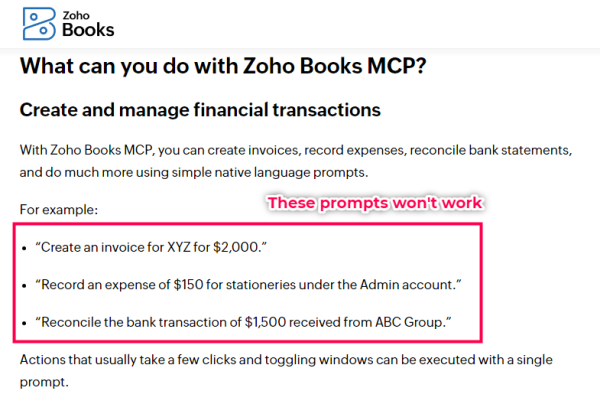
The first example will not work because an invoice needs far more data in the prompt than a single “Create an invoice for XYZ for $2,000”. The real prompt will be very long and should have all the line items you want in the invoice, their quantity, tax settings, and tons of other information. Even a newbie will create an invoice manually times faster than Claude in the prompt mode.
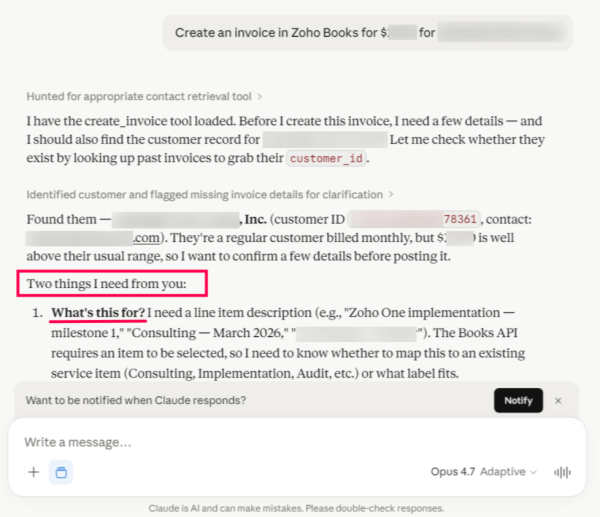
Claude Opus 4.7 executes a prompt for Zoho Books via Zoho MCP
The same is for the “Record an expense of $150 for stationeries under the Admin account” — you can’t create an expense that way. You need to let Claude know who is the merchant, what was the payment method, whether it is reimbursable, and the list goes on. You already guessed that the third example will not work either. None of these tasks can be executed in a single prompt, unless this prompt is very, very long. Making that prompt will take more time than simply doing the operation the normal way.
Long story short, using Zoho Books MCP for the routine accounting operations is using the AI for sake of using the AI, makes no practical sense, and will slow down any accounting department to the level of hibernation. So, is it useless? Not at all.
Where Zoho Books MCP Integration Truly Shine
To make the most of it, the use cases must fall into one of the following categories. It’s not the full list, of course, but it’s a good start:
- Something that Zoho Books cannot show you in a few clicks. For instance, you’re about to issue an invoice and are not sure whether the total amount is within the range you regularly charge for this type of job.
- Getting the data that would otherwise require custom report building.
- Getting the information about the current condition of Zoho Books itself: its custom functions, automations, custom buttons, and more. Zoho MCP’s tools for Zoho Book offer many useful API calls, such as “get custom action”, “get custom button history”, “get custom module”, and others.
- Analyzing the sales trends, audit trails, user activities, and other datasets.
In general, AI must be used with caution, and it’s especially true in the context of accounting operations. Any AI (specifically, large language models like ChatGPT or Claude) struggles with math because it cannot think or understand what it is doing. In 2024, Forbes published a good article on the matter, and here’s more.
In 2026, it’s not much better, given the nature of LLMs. By design, LLMs are predictive engines, designed to predict the next likely word in a sequence based on text data, rather than performing logical, rule-based reasoning. We know that “logical, rule-based reasoning” and math are the core of accounting as a discipline. In math, we do not predict; we calculate. Thus, the most rational approach is to treat Zoho Books MCP integration as a combination of a reporting engine, a system log analyzer, and a relationship finder.
If you’re curious about how your business can benefit from using Zoho Books with Zoho MCP and your favorite AI, ask us: we use it extensively and will be happy to share the details.